
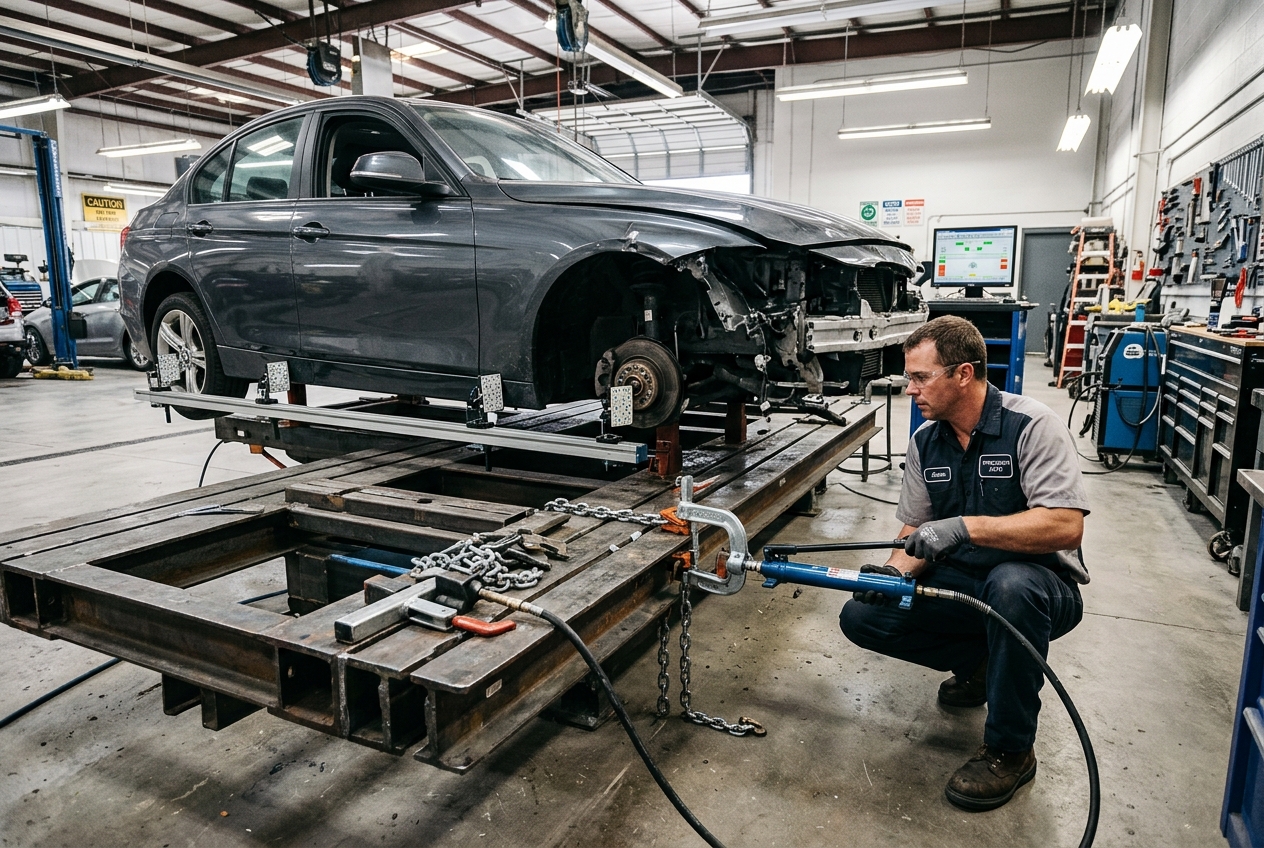
Frame Straightening & Structural Repair — A Safety-Critical Service
Of all the services we provide at Fair Deal Accident Expert, frame straightening is arguably the most safety-critical. When a vehicle's frame or chassis is bent or deformed following a collision, the consequences go far beyond cosmetic — the structural integrity of the car is compromised in ways that may not be obvious but that matter enormously in the event of a subsequent accident. A vehicle with a distorted frame will not crumple in the designed, controlled way that engineers intended; it will distribute impact forces unpredictably, and the safety systems designed to protect you — airbags, seatbelt pre-tensioners, crumple zones — may not perform as expected.
This is why frame and structural repair is a specialist area that demands specialist equipment, specialist training, and an absolute commitment to accuracy. At Fair Deal Accident Expert in Gorgie, Edinburgh, we have the computerised alignment and measuring systems to carry out structural repairs to factory tolerances — and the experienced technicians who know how to use them properly.
How Do You Know If Your Car Has Frame Damage?
This is one of the most important questions you can ask after any significant collision — and the honest answer is that you often cannot tell from a visual inspection alone. Frame damage is frequently hidden beneath undamaged or only lightly damaged bodywork. The outer panels of a modern vehicle are designed to take and absorb impact, and they can appear relatively intact while the structural members beneath have been significantly deformed.
That said, there are some signs that may suggest frame damage is present. Doors that do not open or close properly after an accident, panels that have become misaligned and no longer sit flush with each other, a vehicle that pulls consistently to one side while driving on a straight, level road, unusual tyre wear patterns that develop after a collision, or a steering wheel that is not centred when driving straight — all of these can indicate that the vehicle's structural geometry has been affected.
However, frame damage can also be present without any of these obvious signs. This is why we carry out a full structural inspection using our digital measuring systems at the start of every significant collision repair job. The only way to definitively identify frame damage — and quantify its extent — is to measure the vehicle against the manufacturer's specifications.
Uni-Body and Body-on-Frame Construction — What Is the Difference?
Understanding the type of construction your vehicle uses helps make sense of what frame damage actually means in practical terms.
The vast majority of modern passenger cars use uni-body (unitary body) construction, in which the body and frame are a single integrated steel structure. In a uni-body vehicle, there is no separate chassis — the body panels, floor, pillars, and roof all work together as a single structural unit. This makes uni-body vehicles lighter and more rigid than their predecessors, but it also means that a collision force is distributed throughout the entire structure. Frame damage in a uni-body vehicle can affect multiple interconnected areas of the car.
Some trucks, SUVs, and commercial vehicles use body-on-frame construction, where the body sits on top of a separate ladder-type chassis frame. In these vehicles, it is sometimes possible to address frame damage without affecting the body. However, the repair process and the required accuracy are just as demanding as for a uni-body vehicle.
At Fair Deal, our equipment and technicians handle both types of construction. We will assess your specific vehicle and explain clearly what work is required.
Our Frame Straightening Process
Frame straightening requires a combination of the right equipment, accurate measurement, and skilled technique. Here is how we approach structural repairs at Fair Deal:
Digital measuring and baseline assessment. The vehicle is secured to our frame straightening bench and a full three-dimensional digital measurement is taken of the vehicle's structural geometry. This is compared against the manufacturer's original specification data to identify every deviation from the correct dimensions — not just the most obvious areas of damage. This step is non-negotiable. You cannot carry out frame straightening accurately without measuring first.
Controlled force application. Once the extent and direction of the deformation has been mapped, we begin applying carefully controlled forces to the frame using hydraulic pulling equipment. The direction, magnitude, and sequence of these pulls is calculated to gradually restore the frame to its correct geometry without introducing new stresses or deformation in other areas. This is skilled work that requires experience and patience — rushing it produces poor results.
Continuous measurement and verification. Throughout the straightening process, we continuously re-measure to track progress and verify that the corrections are moving in the right direction. This is an iterative process — we pull, we measure, we adjust, we pull again — until every dimension is within the manufacturer's specified tolerance.
Post-straightening inspection and wheel alignment. Once the frame has been restored to specification, we carry out a comprehensive inspection of the vehicle's suspension, steering geometry, and drivetrain components to identify any damage that may have been caused or revealed by the collision. A wheel alignment check and adjustment is included in all structural repair work, as even minor frame distortion can affect wheel alignment and tyre wear.
Is Frame Damage Covered by Insurance?
Yes — structural damage following a road traffic accident is covered by comprehensive motor insurance policies, and most damage-only policies too. If you were at fault in the accident, the repair will be covered subject to your excess. If the accident was not your fault, we can manage the entire claim through the other driver's insurer at no cost to you — no excess, no impact on your no-claims bonus (subject to the terms of the claim).
We carry out repairs to insurance-approved standards. Contact us before you contact your insurance company — we can advise you on the most beneficial claims route for your specific situation, and we handle all the documentation and communication with the insurer on your behalf.
Modern Vehicle Safety Design and Why Frame Geometry Is Critical
Understanding why frame geometry matters so much requires a brief look at how modern vehicles are engineered for crash safety. Modern cars are not simply rigid boxes — they are carefully engineered structures that are designed to deform in very specific, controlled ways during a collision. Crumple zones at the front and rear of the vehicle are designed to absorb and dissipate impact energy progressively, reducing the force transmitted to the occupant cabin. The cabin itself is constructed as a rigid safety cell — a strong cage that is intended to remain intact while the surrounding structure collapses around it.
This engineering is sophisticated and precise. The thicknesses of different steel sections, the positioning of reinforcements, and the overall geometry of the vehicle's structure all work together to produce the crash behaviour the engineers designed. When the frame is bent or twisted out of its designed geometry, this carefully calculated crash behaviour is disrupted. Crumple zones may not absorb energy in the intended sequence. The rigid safety cell may not be as rigid as designed. Airbag deployment — which is triggered by sensors that detect specific deceleration patterns — may not function correctly.
This is why we will never tell a customer that frame damage is “just cosmetic” or that it “does not need fixing.” It is a safety issue, and it deserves to be treated as one. Our goal with every structural repair is to return the vehicle to the precise geometry it had when it left the factory — so that if the worst happens and the vehicle is involved in another collision, it will protect its occupants exactly as the manufacturer intended.
After Frame Repair — What to Expect From Your Vehicle
Once frame repair is complete, most drivers notice an immediate improvement in how their vehicle drives. A car with a distorted frame often develops subtle but noticeable handling characteristics — a tendency to pull to one side, unusual steering feel, or tyres that wear unevenly because the wheel geometry is not correct. All of these symptoms typically disappear once the frame is restored and the wheel alignment is set correctly.
We recommend having your tyre pressures checked and your driving assessed by yourself carefully after collecting a vehicle from a structural repair. Most customers find their car feels noticeably better than it did even before the accident that caused the damage — because in many cases, the vehicle had pre-existing alignment issues that had developed gradually and had simply been accepted as normal. With correct geometry restored, everything feels as it should.
We also recommend a follow-up tyre wear check after approximately 3,000 miles following a structural repair. This allows us to confirm that the wheel alignment is stable and that tyres are wearing evenly across all four corners. If any adjustment is required, we will carry it out promptly at no additional charge as part of our commitment to the quality and completeness of our work.
Structural Repair Serving Edinburgh and Surrounding Areas
Our Edinburgh body shop on Fords Road handles structural repairs for drivers from across the city. We are conveniently located just off the A71 Calder Road in Gorgie and easily reached from anywhere in Edinburgh via the A720 bypass. We regularly see vehicles brought in for frame straightening from Corstorphine, Wester Hailes, Sighthill, Morningside, Leith, Portobello, Dalkeith, Musselburgh, and Loanhead. If your vehicle has been in a significant collision, please do not delay — contact us for a free structural assessment as soon as possible.
Can a car with frame damage be properly repaired?
In most cases, yes. Modern frame straightening equipment and techniques can restore structural geometry to factory tolerances even after significant deformation. However, there are situations where the damage is so severe that repair is not viable — in those cases, we will be completely honest with you and advise accordingly.
How do I know when the frame is properly straightened?
We provide a digital measurement report showing your vehicle's structural dimensions before and after repair, both compared to the manufacturer's specifications. This gives you documented proof that the frame has been restored to the correct geometry.
Will frame damage affect my car's value permanently?
A properly documented frame repair, carried out to manufacturer specification and backed by a lifetime guarantee, should not significantly affect your car's value. Undisclosed frame damage, or frame damage repaired poorly, is a different matter. This is why choosing a reputable repairer and obtaining documentation of the repair is so important.